|
|
USA Ranks Last In Health Care - Again
 Bahamut.Kara Bahamut.Kara
Serveur: Bahamut
Game: FFXI
Posts: 3544
By Bahamut.Kara 2014-06-18 00:06:37
On the topic of medications... because of the way pharma patents work, a company has only a few years (5 iirc) of exclusivity on a medicine before it is able to be made by generic manufacturers at a much lower consumer cost. That means they have a limited time to recoup the cost of development. Drug companies need to constantly produce new drugs in order to make the money required to research and develop them. Whether the new drugs are any better than old ones is irrelevant to them. That's good and bad, as those dollars fund research of new and better drugs for a lot of things (though a LOT of research dollars are provided to them via grants and subsidy from the government). On the bad end, it encourages them to be constantly pushing new drugs that aren't any better than old ones and a much higher cost.
Without socializing pharma research, you can't really eliminate this, but the major driving force behind demonization of ACA from the beginning is that expanded medicaid will not be willing to pay for new/expensive drugs when a generic is available. Pharma has one of the most powerful lobbies in america and it's no surprise that a pharma lobbyist was the one who coined "Obamacare".
On a side note, for anyone who thinks pharma companies are great, Merck, one of the largest manufacturers of drugs, routinely takes US government research grants to develop new medicines that they then say are owned by an oversea subsidiary in order to avoid paying taxes to the tune of an estimated minimum 2 billion dollars a year.
Drugs are patented for a base of 20 years in US. Most of the money spent in the first two phases of drug development are US grants or tax deductibile. The pharma industry average profit margin in 2012 was 16.7%.
Demythologizing the high costs of the pharma industry is a counter paper to the 2003 paper from Tuft university claiming that it takes almost $1 billion to get a new drug to market.
Here is a slate article that goes over some of the paper
[+]


Bahamut.Kara
Serveur: Bahamut
Game: FFXI
Posts: 3544
By Bahamut.Kara 2014-06-18 00:12:35
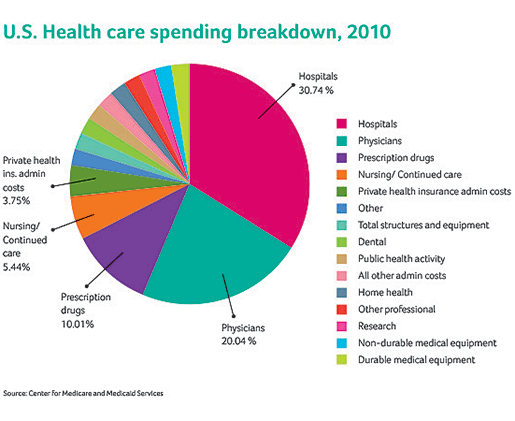
Bahamut.Baconwrap said: »Research 4%~ (generous estimate) and if we addprescription drugs that's a total of 14.01%.not even close to the majority of costs.
The lifespan costs for an individual with a chronic condition like HIV, Hepatitis, Cancer, Diabetes are going be a lot more money than an acute issue that requires one visit to the hospital. Oh, absolutely.
Those percentages were from total healthcare costs ($2.6 trillion~ in 2010) according to cme.gov
Individual treatments, for various issues, would vary widely in cost breakdown, I would think.
By marivell 2014-06-18 00:20:16
(I know, except from Quebec maybe in 2006, I'm not sure if they still maintain it).
Ok lemme make it clear to you:
I am a pharmacist. I'm working in both hospitals and public pharmacies. So I know the system and how it works just fine thank you.
Yes, it's still going in Quebec as I deal with as many private clinics than public ones nowadays.
In fact, private clinics are growing very fast here http://www.cmaj.ca/content/183/8/E437.full
Atleast tho we do agree on one thing: americans and canadians, especially quebeckers, aren't alike on many aspects of their lives.
I don't care giving away 1/4 + of my paycheck, as long as it allows less fortunate ppl to gain access to free healthcare, among other things.
I was just pointing out that it's hard for me and many others to understand that freedom to choose a healthcare professional is a more valuable thing to you than the health of others... I just can't, I'm sorry, just like you probably can't understand us either.
Also we don't say here people receiving healthcares are consumers: they are patients. We take care of them, not selling them a service. :)
On this note, have a nice evening!
Serveur: Carbuncle
Game: FFXI
Posts: 410
By Carbuncle.Snoochybooch 2014-06-18 00:23:39
VIP
Serveur: Odin
Game: FFXI
Posts: 9534
By Odin.Jassik 2014-06-18 00:25:21
On the topic of medications... because of the way pharma patents work, a company has only a few years (5 iirc) of exclusivity on a medicine before it is able to be made by generic manufacturers at a much lower consumer cost. That means they have a limited time to recoup the cost of development. Drug companies need to constantly produce new drugs in order to make the money required to research and develop them. Whether the new drugs are any better than old ones is irrelevant to them. That's good and bad, as those dollars fund research of new and better drugs for a lot of things (though a LOT of research dollars are provided to them via grants and subsidy from the government). On the bad end, it encourages them to be constantly pushing new drugs that aren't any better than old ones and a much higher cost.
Without socializing pharma research, you can't really eliminate this, but the major driving force behind demonization of ACA from the beginning is that expanded medicaid will not be willing to pay for new/expensive drugs when a generic is available. Pharma has one of the most powerful lobbies in america and it's no surprise that a pharma lobbyist was the one who coined "Obamacare".
On a side note, for anyone who thinks pharma companies are great, Merck, one of the largest manufacturers of drugs, routinely takes US government research grants to develop new medicines that they then say are owned by an oversea subsidiary in order to avoid paying taxes to the tune of an estimated minimum 2 billion dollars a year.
Drugs are patented for a base of 20 years in US. Most of the money spent in the first two phases of drug development are US grants or tax deductibile. The pharma industry average profit margin in 2012 was 16.7%.
Demythologizing the high costs of the pharma industry is a counter paper to the 2003 paper from Tuft university claiming that it takes almost $1 billion to get a new drug to market.
Here is a slate article that goes over some of the paper
Thank you for the link, I didn't think it would be productive to debate the actual cost of research.
The 5 years I was thinking was from an article I read a few month ago about a particular allergy drug and the time remaining.
[+]

Serveur: Fenrir
Game: FFXI
Posts: 3344
By Fenrir.Weakness 2014-06-18 00:36:09
I don't even know where to begin with you Keityan...
Quote: This only affects "for profit" health organizations and governmental regulations on such things (such as surgicenters) have been outlawed to start up. Nonprofits profits are reinvested to lower premiums ore increase care.
All insurance companies are for profit. The only not-for-profit organizations are government owned, which means funded by taxes. ACA is requiring insurance, government owned or not, which means you are paying higher rates for the same quality you used to have from your for profit insurance from your employer or you are getting a lesser standard of care to cover more people at a significant loss which has to be recouped some how (increased taxation).
ACA was probably the worst way to go about healthcare reform, because it should be about lowering healthcare costs not insurance costs that we should be worried about.
Quote: The grandfathered plans don't work. As I said, everyone tends to overeat at an all you can eat buffet. This is no different from healthcare. You need to add restrictions to keep health costs down. This is simply being realistic and supply and demand. You need to pay the health care providers somewhere. Doctors need to be compensated for their high education (and standards). You can either lower the standards of care and hire more less qualified doctors and treat everyone or have the best doctors treat some. You need to strike a balance.
When not allowing grandfathering for new plans what you are doing is displacing tens of millions of people who had healthcare through their employment. So in essence you are lowering their care while stagnating costs to create plans to conform with the new laws.
Quote: This is speaking from mis-informed news stations. The younger you are, the less likely you are to have breast cancer (or any cancer). At this point, it comes down to mathematics and budget. You're not going to perform mammograms on the whole population of 20 year olds for .01% chance of breast cancer (made up numbers, I'll actually look it up for you if you really don't get the picture).
Actually I am speaking from personal experience. My highest quality plan removed things formally paid for (free yearly physical, yearly flu shot, yearly eye exam to name a few... notice a pattern?) and increased costs to conform to new guidelines. And all of the new options available still have even less care provided. My only options are either keep Aetna through my work at a discounted rate (no other companies available) or pay even more for private insurance or resort to government run insurance, both of which will lower my care available while neither will decrease the cost.
Reread my quote about breast exams, you skipped some words. The entire point was to push preventative care to the top of priorities for insurance. I'm saying you should go to your family practice when you feel ill or have questions because in the long run the amount of prevention that would cause would vastly outweigh the costs of treatment otherwise for most cases.
Quote: You can not provide everyone care if the government gives the type of coverage that corporations provide without raising taxes or creating restrictions on the type of care you receive. You're talking as if the government is a bottomless pit of money. It's not.
I'll agree with preventative care. If you're a doctor, you'll realize that problem isn't education but it's about compliance. Saying otherwise is simply disingenuous. Quote: It is implicit that all the medicine will be used when there is scientific reason to support it. If the main goal is lower blood pressure with no pre-existing conditions, it is obvious the cheapest option is the ideal choice. There's no reason to use more expensive drugs for the same desired effect. The research committee works on the side-effects as well. You should read up on it.
Did you just completely miss the point I was trying to make? I'll spell it out. No two people are the same, giving the same medication is not always the correct answer. This is why we have different types of medication, that work in different routes, to achieve the same effect.
To continue your same example, a loop diuretic would be cheaper than an ACE inhibitor. But the ACE inhibitor will have fewer negative effects (not having to pee all the time) and less complications with people who have a history of hypertension (the entire reason people are taking either of these drugs). This will make the ACE inhibitor the better drug to prescribe more often, despite being more expensive. Again, standard of care.
Medication should be prescribed on a per patient basis, not based on the effect they achieve. And to have lower costs of different types of medications is to allow generics to be made faster or put a ceiling on market prices, both of which are going to have a negative effect on R&D of new drugs.
I really hope you're not in the medical field if you can't wrap your head around giving the best possible care available per patient.
And increasing basic public health education would help with compliance. Understanding that it is cheaper in the long run to follow through with basic preventative care than a single ER visit, explaining that you should get a flu shot every year, that going to you shouldn't use ERs as primary care when your child has a fever.... just trying to get the basics of what are running up healthcare costs to the public and educate them on different and cheaper means to their problems.
[+]

Bahamut.Kara
Serveur: Bahamut
Game: FFXI
Posts: 3544
By Bahamut.Kara 2014-06-18 00:42:29
Energy costs you can can directly account for. R&D would be an indirect cost and how much it affects costs would be interesting to see.
If you could show me where increased r&d accounts for our raised healthcare costs i'd like to read it....which is why i mentioned it. Indirect only to the total cost of healthcare, and only if you use cost accounting. Which only applies to manufacturing companies.
Yes, manufacturing companies do use research and development to produce better products, but last I saw, healthcare is a service industry.
Unless you assume that pharmaceuticals = all of the healthcare industry which nobody does.
But I wouldn't expect an "economist" or whatever you do to know that. Wow.
1. I was talking about total healthcare costs
2. I wasn't referring to accounting principles when discussing direct and indirect costs. I was referrring to cost engineering which is the absolute breakdown of costs per project, product, or in this instance procedure, therapy, treatment, etc. While developed specifically for engineering projects its been commandeered by multiple industries to get a complete understanding of the actual costs incurred or projcted. Used specifically for business/project planning and quote estimation.
3. Snark reply: if you had ever taken a cost/benefit analysis course maybe you would understand.
Quote: Well according to an insurance company this is the breakdown in costs And how much does the world in total spend on research and development again?
Because, if you read what I stated:
The reason why healthcare is unaffordable in America is that we are funding nearly the entire R&D of the world.
You didn't exactly do anything but prove my point.
What?
Leaving off the fact that you are making the extraordinary claim that all R&D affects the rise in healthcare costs without any backup citation, the US doesn't fund nearly all of the R&D in the world.
Quote: Quote: PricewaterhouseCoopers calculates that up to $1.2 trillion, or half of all health care spending, is the result of waste.
Correct. But to PWC, waste is considered to be unproductive research. Meaning research that ended up being proven ineffective or incorrect.
Others may see that to be learning what is not right. But to each his own.
No.
This figure ($1.2 trillion) is not about research but about total healthcare costs. The total R&D costs (all industries, all countries) in the world is only a little over $1 trillion
Quote: Our research found that wasteful spending in the health system has been calculated at up to $1.2 trillion of the $2.2 trillion spent in the United States, more than half of all health spending. Defensive medicine, such as redundant, inappropriate or unnecessary tests and procedures, was identified as the biggest area of excess, followed by inefficient healthcare administration and the cost of care necessitated by conditions such as obesity, which can be considered preventable by lifestyle changes. PwC's paper classified health system inefficiencies into three “wastebaskets” that are driving up costs:
1. Behavioral where individual behaviors are shown to lead to health problems, and have potential opportunities for earlier, non-medical interventions.
2. Clinical where medical care itself is considered inappropriate, entailing overuse, misuse or under-use of particular interventions, missed opportunities for earlier interventions, and overt errors leading to quality problems for the patient, plus cost and rework.
3. Operational where administrative or other business processes appear to add costs without creating value.
[+]
Serveur: Bahamut
Game: FFXI
Posts: 5381
By Bahamut.Baconwrap 2014-06-18 00:43:23
On the topic of medications... because of the way pharma patents work, a company has only a few years (5 iirc) of exclusivity on a medicine before it is able to be made by generic manufacturers at a much lower consumer cost. That means they have a limited time to recoup the cost of development.
The big bucks right now in pharma industries is coming from Hep C medications. Merck hates Gilead Sciences with a passion and has made that very clear with several lawsuits going at eachother and with every right. Gilead Sciences is going to make Merck a thing of the past in the next few years...
Gilead Strikes First in Latest Round of HCV Patent Wars
Watch out, Gilead. Merck is mounting a hep C combo comeback
f
HCV meds are serious business because up until now HCV meds specifically interferon alfa(via Merck) have some pretty harsh side effects. Gilead Sciences' Sofosbuvir is completely different.
But this wasn't the first shot to Merck's portfolio. Isentress(Merck) along with Truvada(Gilead Sciences) was a staple in HIV therapies for a long time. No more, Gilead Sciences pretty much crushed Merck with the introductions of HIV one-a-day therapies Atripla, Complera and Stribild.
The sad part is neither of these companies cares about consumer costs.
EDIT: The funny part of this story is that numerous public health scientists including AHF president warned the approval of Truvada as PrEP would increase cases of Hep C in the US. Guess who was one of the major backers$$$ of Truvada as PrEP? Gilead Sciences...the same company who produces Truvada(HIV med and PrEP) and Sofosbuvir(HCV med)
[+]
 Bismarck.Keityan Bismarck.Keityan
Serveur: Bismarck
Game: FFXI
Posts: 323
By Bismarck.Keityan 2014-06-18 00:50:43
(I know, except from Quebec maybe in 2006, I'm not sure if they still maintain it).
Ok lemme make it clear to you:
I am a pharmacist. I'm working in both hospitals and public pharmacies. So I know the system and how it works just fine thank you.
Yes, it's still going in Quebec as I deal with as many private clinics than public ones nowadays.
In fact, private clinics are growing very fast here http://www.cmaj.ca/content/183/8/E437.full
Sure! I still didn't doubt you whether it still holds but still, Quebec is not the majority or even remotely close to all of Canada. It's the exception and in this case and you as a citizen of Canada should know about this more than I should.
Atleast tho we do agree on one thing: americans and canadians, especially quebeckers, aren't alike on many aspects of their lives.
I don't care giving away 1/4 + of my paycheck, as long as it allows less fortunate ppl to gain access to free healthcare, among other things.
You say this like we don't pay 1/4+ of our paychecks either. You're forgetting Medicare comes out of our paycheck to pay for our elderly and we ALSO have the same issue of taking care of the baby boomers because both of our systems work upon the working population to pay for the elderly.
However, "access to a queue of healthcare" is not "access to healthcare". The only place where healthcare functions more like our current US is your Quebec. As a country, you simply don't have enough doctors to maintain care.
Also we don't say here people receiving healthcares are consumers: they are patients. We take care of them, not selling them a service. :)
Very noble in words. However, hypocritical since Quebec values personal interest to defy Canadian law. That said, if you really believe what you say, about caring of your social values, Quebec's system is exactly what you _don't_ want. By trying to care for everyone, no one has the freedom to chose their own care. If Quebec's system works with new private clinics(Paid per visit), you now have the same situation as the US and having the same issues, and having massive queue lines everywhere else.
VIP
Serveur: Odin
Game: FFXI
Posts: 9534
By Odin.Jassik 2014-06-18 00:53:18
3. Snark reply: if you had ever taken a cost/benefit analysis course maybe you would understand.
Reread this twice before it sunk in, then I lol'd really hard.
[+]
Serveur: Bahamut
Game: FFXI
Posts: 5381
By Bahamut.Baconwrap 2014-06-18 00:59:52
Drugs are patented for a base of 20 years in US.
This official working with Kaiser commented on the US government and pharm pricing.
Quote: But Dr. Sharon Levine, a top official working on drug policy with insurer Kaiser Permanente, disagrees.
“There was never any question that we would cover and prescribe this drug,” said Levine. But she firmly believes the price is out of line. Countries where the government sets drug prices are paying much less, she noted. Quote: In many countries, the government sets drug prices. In the U.S., insurers negotiate with drug companies. Medicare is forbidden from bargaining, a situation that critics say saddles U.S. patients with high costs while subsidizing the rest of the world.
[+]
Bismarck.Keityan
Serveur: Bismarck
Game: FFXI
Posts: 323
By Bismarck.Keityan 2014-06-18 01:26:46
All insurance companies are for profit.
I cant argue against someone who doesn't even have the right facts. So let's play a game. Instead of me telling you how it works, let me ask you how it works.
What defines Health insurance? How is it calculated? Are there different types? First thing first, before you answer that, I will tell you that you will find that your above statement is wrong. I can even list you two of the top three providers of health insurance in the US, which is independent _non-profit_ and even give you a detailed history of how they established themselves and _I don't even work for them_.
I'm sorry for your loss of coverage. I can understand your frustration as well. Unfortunately, the issue is that we can be blindly optimistic or we can be realistic. If I were a physician, I would do all that I can for all my patients to the best of my ability. But external factors such as cost needs to be considered. If you really think you can make a difference, I encourage you to take a $300k debt to go to medical school to be a doctor, and work for free.
I'm also sorry for your loss of your yearly flu shot. This doesn't always have to do with cost too though. You must realize that, as a working class member of society, you have the _least_ chance of dying to the flu. On the other hand, the flu kills the young and the elderly and there is only a finite amount of flu vaccine that can be made each year. These reasons aren't always related to cost. I don't know much about your situation or health insurance plan, so I can not comment on this. In some Flu vaccine cases, you might be saving a life by opting out.
But as I said, I agree that preventative medicine is the path to success (as well as education for the public). Easier said than done. The bottom line is that there must be scientific evidence that corroborates their effectiveness.
As for your textbook answer of diuretics and "no two patients are the same". You'd be surprised that cyanide does indeed kill 99.99999% of people if consumed in high quantities. While this, a very insensitive analogy. I'm sorry to tell you most people are like everyone else biochemically and this is exactly how FDA approves drugs (if they have a high percentage of WORKING). So if you have a drug that works on 80% of patients, you'd bet on that first. You wouldn't bet on a drug that works on 20% of patients that costs 10x more. You wouldn't even bet on a drug that works on 80% of the patients at 10x more. Still, you realize that by adding some parts of "quality of life" for you by opting to use an alpha blocker instead of a diuretic with no pre-existing conditions means that money will come OUT somewhere else. This equates to someone else who depends on that care to survive. The money has the come from somewhere, I can not stress this enough for you.
Serveur: Fenrir
Game: FFXI
Posts: 3344
By Fenrir.Weakness 2014-06-18 02:01:35
All insurance companies are for profit.
I cant argue against someone who doesn't even have the right facts. So let's play a game. Instead of me telling you how it works, let me ask you how it works.
What defines Health insurance? How is it calculated? Are there different types? First thing first, before you answer that, I will tell you that you will find that your above statement is wrong. I can even list you two of the top three providers of health insurance in the US, which is independent _non-profit_.
This is just basic wiki right here...
Quote: The 14-state WellPoint is the largest Blue Cross Blue Shield plan, and is a publicly traded company. Quote: Aetna, Inc. /ˈɛtnə/ is an American managed health care company, which sells traditional and consumer directed health care insurance plans and related services, such as medical, pharmaceutical, dental, behavioral health, long-term care, and disability plans. Aetna is a member of the Fortune 100. Quote: Humana Inc. is a for-profit American managed health care company that markets and administers health insurance in the United States Quote: UnitedHealth Group Inc. is a diversified managed health care company headquartered in Minnetonka, Minnesota, U.S. It is No. 14 on Fortune magazines top 500 companies in the United States.[5] UnitedHealth Group offers a spectrum of products and services through two operating businesses: UnitedHealthcare and Optum. Through its family of subsidiaries and divisions, UnitedHealth Group serves approximately 70 million individuals nationwide. In 2011, the company posted a net earnings of $5.142 billion.[4]
Cigna is also for profit, just couldn't find a good quote, but you get the drift? Just because a company helps run medicare/medicaid for a state doesn't mean they aren't for profit.
Quote: As for your textbook answer of diuretics and "no two patients are the same". You'd be surprised that cyanide does indeed kill 99.99999% of people if consumed in high quantities. While this, a very insensitive analogy. I'm sorry to tell you most people are like everyone else biochemically and this is exactly how FDA approves drugs (if they have a high percentage of WORKING). So if you have a drug that works on 80% of patients, you'd bet on that first. You wouldn't bet on a drug that works on 20% of patients. Still, you realize that by adding some parts of "quality of life" for you by opting to use an alpha blocker instead of a diuretic with no pre-existing conditions means that money will come OUT somewhere else. To someone else who depends on that care to survive.
Again.
You're still completely missing the point. You listed several different drugs that have the same end result, lowering blood pressure. But you are failing to realize that they all work on the body in very different ways, and if prescribed incorrectly would kill someone.
This next part is important.
Just because a drug has the same end result, does not make them the same type of drug. A patient should always have a proper consult when medication is prescribed to fit their need. That is the basics for standards of patient care. That is why there are different medications for the same condition.
An Alpha-inhibitor would reduce vaso-constriction, a Beta-blocker reduces heart rate, a calcium channel-blocker reduces contractility, an ACE-inhibitor reduces the volume of blood. They are all prescribed for the same blanket condition, hypertension. But just because one cause of hypertension is more common than another does not mean that one drug is right for two people with the same cause of that condition.
In terms of statistics, yes they will probably be prescribed the same thing. In terms of patient care, they should both consult with their physician to decide what is the best course of treatment for them.[/u]
Bismarck.Keityan
Serveur: Bismarck
Game: FFXI
Posts: 323
By Bismarck.Keityan 2014-06-18 02:29:58
This is just basic wiki right here...
Except you failed basic wiki skills by stating that all health insurance are all "for profit" entities. Look up: Kaiser Permeante. I know when I'm winning an argument when someone starts resorting to memes. http://www.ehealthinsurance.com/health-insurance-companies/kaiser-permanente/ . I'm not a fan of Huffington Post but:
"The top-scoring brand in the survey was Kaiser, a nonprofit, integrated health care provider available to consumers in at least nine states, including California and Colorado. The top-ranked plan in the country was the Harvard Pilgrim HMO, which is available to residents of Massachusetts, Maine and New Hampshire."
You're still completely missing the point. You listed several different drugs that have the same end result, lowering blood pressure. But you are failing to realize that they all work on the body in very different ways, and if prescribed incorrectly would kill someone
As I said, this is implicit. It's so obvious that I don't understand what you're arguing about. You're a doctor. You have to prescribe a drug to someone with no pre-existing conditions with high blood pressure. You don't just roll dice and say "Oh, you get ACE inhibitors!" You go with sound scientific evidence and patient history FIRST before resorting to higher cost drugs. Your first line of defense should be the least expensive drug that works on the most amount of people. What part of "drug costs money" doesn't make sense to you?
[+]
Serveur: Fenrir
Game: FFXI
Posts: 3344
By Fenrir.Weakness 2014-06-18 02:46:41
Dude... really.
Quote: The two types of organizations which make up each regional entity are:
Kaiser Foundation Health Plans (KFHP) work with employers, employees, and individual members to offer prepaid health plans and insurance. The health plans are not-for-profit and provide infrastructure for and invest in Kaiser Foundation Hospitals and provide a tax-exempt shelter for the for-profit medical groups.
Permanente Medical Groups are physician-owned organizations, which provide and arrange for medical care for Kaiser Foundation Health Plan membersin each respective region. The medical groups are for-profit partnerships or professional corporations and receive nearly all of their funding from Kaiser Foundation Health Plans. The first medical group, The Permanente Medical Group, formed in 1948 in Northern California.
So the company is run as a charity, but still relies on for profit groups to actually treat patients. While Kaiser is big no doubt (roughly 9 million), they are dwarfed by the big 5 listed above.
And BCBS is a coalition of companies that function as one, not a single company. Wellpoint (the biggest company in BCBS) is a for profit company, as noted above. And pretty much all of the companies involved in BCBS are for profit.
Quote: As I said, this is implicit. It's so obvious that I don't understand what you're arguing about. You're a doctor. You have to prescribe a drug to someone with no pre-existing conditions with high blood pressure. You don't just roll dice and say "Oh, you get ACE inhibitors!" You go with sound scientific evidence and patient history FIRST before resorting to higher cost drugs. Your first line of defense should be the least expensive drug that works on the most amount of people. What part of "drug costs money" doesn't make sense to you?
You just completely contradicted yourself. It is about patient care what which drug is best for that patient, not about how much each drug costs.
Quote: Just because a drug has the same end result, does not make them the same type of drug. A patient should always have a proper consult when medication is prescribed to fit their need. That is the basics for standards of patient care. That is why there are different medications for the same condition.
Bismarck.Keityan
Serveur: Bismarck
Game: FFXI
Posts: 323
By Bismarck.Keityan 2014-06-18 03:04:58
So the company is run as a charity, but still relies on for profit groups to actually treat patients. While Kaiser is big no doubt (roughly 9 million), they are dwarfed by the big 5 listed above.
-------------
Oh, did I hear someone take back the: All insurance companies are for profit. and try to justify why this non-profit health insurancer is actually for-profit ad hoc? That's cute.
You're naive. And I'm only condescending when you feign like you know the policy (but you actually don't). Meme's and all, if you really must make something up, goddammit, look it up first or state that it's an example statistic. The Health Insurance that Kaiser provides is non-profit. They work under a capitation system (bet you can't wiki that under Kaiser Peremanete). You pay the health insurance company (Kaiser) a monthly payment and they manage your care with their system of doctors. Yet, Kaiser's quality of care is as high as traditional health insurance and is 20% less expensive. This is because they added efficiency to the system, which I can probably write you a chapter about if it's not on wiki. Perhaps under some conditions, for profit physicians work more efficiency, who knows. You still can not deny that Kaiser is non-profit, and collectively _decreases_ health costs for their members. (and re-invests their profits to increase care or decrease costs etc. etc etc. Look up non-profit organizations).
Serveur: Fenrir
Game: FFXI
Posts: 3344
By Fenrir.Weakness 2014-06-18 03:13:50
You seriously just gave a link to the "Top Health Insurance Companies," not the "Biggest Health Insurance Companies" to state that it is one of the biggest companies.
http://pharmacy.about.com/od/Insurance/a/The-Big-Five-Health-Insurance-Companies.htm
Quote: WellPoint has 34 million members in its affiliated health plans and more than 70 million insurees when its subsidiaries are included. Quote: CIGNA has 11.4 million insurees in the U.S. and another 7.6 million outside the U.S. (in 29 different countries) and is ranked Number 129 on the Fortune 500 list. Quote: Aetna was founded in 1853 in Hartford, Conn., and provides healthcare, dental, pharmacy, group life, and disability insurance, and employee benefits. It has almost 18 million medical members, 13.5 million dental members, and 8.5 million pharmacy members. Quote: Humana has 10.2 million medical members and is Number 73 on Fortune magazine's list of the largest U.S. companies, ranked by annual revenue. Quote: UnitedHealthcare is an operating division of UnitedHealth Group, the largest single health carrier in the United States. The company was formed in 1977 through the reorganization of Charter Med Inc., which was established in 1974.
The company provides products and services to some 70 million Americans and its pharmaceutical management programs provide more affordable access to drugs for 13 million people. Oh, did I hear someone take back the: All insurance companies are for profit. and try to justify why this non-profit health insurancer is actually for-profit ad hoc? That's cute.
You're naive. And I'm only condescending when you feign like you know the policy (but you actually don't). Meme's and all, if you really must make something up, goddammit, look it up first or state that it's an example statistic. The Health Insurance that Kaiser provides is non-profit. They work under a capitation system (bet you can't wiki that under Kaiser Peremanete). You pay the health insurance company (Kaiser) a monthly payment and they manage your care with their system of doctors. Yet, Kaiser's quality of care is as high as traditional health insurance and is 20% less expensive. This is because they added efficiency to the system, which I can probably write you a chapter about if it's not on wiki. Perhaps under some conditions, for profit physicians work more efficiency, who knows. You still can not deny that Kaiser is non-profit, and collectively _decreases_ health costs for their members. (and re-invests their profits to increase care or decrease costs etc. etc etc. Look up non-profit organizations).
Forgive me, I missed one company that is barely in 9 states, and is one the largest in none of those states.
And as it turns out you can wiki Capitation.
http://en.wikipedia.org/wiki/Capitation_(healthcare)
Let me hit on this in a little more detail.
Basically they are offering flat rates to consumers for health insurance, the problem being that only a select group are going to accept this insurance. So off the bat you are lowering you options, which in turn means you can't shop around for a doctor for whatever reason. If for whatever reason you get stuck in a position where you aren't near a hospital or doctor or "emergent care clinic" or what have you that accepts this insures (god forbid you go out of state), you are stuck with the whole bill.
Sounds like a really really really shitty HMO, and if you call 911 (you seldom get a choice in which hospital you go to contrary to belief) you're up ***creek and stuck with an enormous hospital bill if they take you anywhere other than a Kaiser facility.
Bismarck.Keityan
Serveur: Bismarck
Game: FFXI
Posts: 323
By Bismarck.Keityan 2014-06-18 03:18:03
You just completely contradicted yourself. It is about patient care what which drug is best for that patient, not about how much each drug costs.
Let me spell this out for you.
1. You're a doctor.
2. You need to deduce which blood pressure med you need to give.
3. Your patient is normal other than blood pressure.
4. You have 3 drugs to choose from (example for simplicity). Ace, Alpha, Diuretic. They all work the some effectiveness in clinical trials.
5. Choose a drug.
With the information given, you simply can't choose which one is better.(Hint, because you don't know) As I said, individual side-effects (to changing drugs) is IMPLICIT. No one prescribes drugs that don't work or causes harmful effects to patients. The best course of action is to choose the least expensive drug.
You overestimate the amount of tests clinicians can take to determine which drug is best for you. For allergies, I won't give you Allegra, Zyrtec before I've tried giving you Claratin.
Bismarck.Keityan
Serveur: Bismarck
Game: FFXI
Posts: 323
By Bismarck.Keityan 2014-06-18 03:27:43
You seriously just gave a link to the "Top Health Insurance Companies,"
Sure, but I never stated that it was the biggest (Ctrl+F + Big). You are still wrong that all health insurance are for-profit organization. Either way, profit or not, healthcare.gov should handle the variations of care. If a for-profit organization can create a system that is cost effective, they really _do_ deserve to profit off of it if they can compete against non-profits. This is based on efficiency. This is exactly what we want.
All insurance companies are for profit.
Still wrong.
Serveur: Fenrir
Game: FFXI
Posts: 3344
By Fenrir.Weakness 2014-06-18 03:30:25
You just completely contradicted yourself. It is about patient care what which drug is best for that patient, not about how much each drug costs.
Let me spell this out for you.
1. You're a doctor.
2. You need to deduce which blood pressure med you need to give.
3. Your patient is normal other than blood pressure.
4. You have 3 drugs to choose from (example for simplicity). Ace, Alpha, Diuretic. They all work the some effectiveness in clinical trials.
5. Choose a drug.
With the information given, you simply can't choose which one is better.(Hint, because you don't know) As I said, individual side-effects (to changing drugs) is IMPLICIT. No one prescribes drugs that don't work or causes harmful effects to patients. The best course of action is to choose the least expensive drug.
You overestimate the amount of tests clinicians can take to determine which drug is best for you. I won't give you Allegra, Zyrtec before I've tried giving you Claratin.
You give the one that has the least negative effects and least potential for side effects, to give the best quality of life for the patient. Which with the given 3 would be an ACE inhibitor, which also happens to be the most expensive.
In the case of allergy medications, I wouldn't prescribe any because they are all OTC. If you need a prescription for allergy medications you obviously have a need beyond the OTCs.
Actually knowing what drugs do before prescribing them is apparently a *** up concept.
Bismarck.Keityan
Serveur: Bismarck
Game: FFXI
Posts: 323
By Bismarck.Keityan 2014-06-18 03:39:09
You give the one that has the least negative effects and least potential for side effects, to give the best quality of life for the patient. Which with the given 3 would be an ACE inhibitor, which also happens to be the most expensive.
You contradict yourself. If every patient was "unique" and no two patients are the same, why is that most of them have the least side effect to the same one? You can't make this argument when it is convenient for you and back off from it now.
Sorry to break it to you, they all have side effects. In fact, every drug that does something will have a side effect.
Cost: But when you think about cost, money paying for ACE inhibitors for patients by default, you are raising the quality of life for yourself. Noble cause. But money in the collective health insurance will have to be deducted somewhere else from conditions are much more severe than high blood pressure. For a little bit of comfort (peeing a bit more often), you can cost someone else's entire life.
Bismarck.Keityan
Serveur: Bismarck
Game: FFXI
Posts: 323
By Bismarck.Keityan 2014-06-18 03:58:36
In the case of allergy medications, I wouldn't prescribe any because they are all OTC. If you need a prescription for allergy medications you obviously have a need beyond the OTCs.
Obviously, I will not change your mind which is unfortunate. In this case, I'm glad that you're not in the health care field because your ignorance is exactly what is making health care costs unmanageable.
I will part with you one last piece of advice for your last quote because there is simply nothing a biochemist working in biotech can make you change your mind. Old drugs don't necessarily mean they are inferior to newer ones. You'd be surprised how little each drug is juxtaposed to each other without the US government actually creating an agency to determine their effectiveness to each other. The ones that are UTC ones that regulated (abuse etc.), or are new enough that are not deemed safe for OTC use. These are usually the new drugs that were patented. Clartin, Zyrtec, and Allegra were all once UTC drugs but their patents expired. This doesn't mean that they are less effective. It just means that people have been using them long enough and they seem "safe enough" for consumers to medicate themselves. Good physicians will still prescribe OTC drugs if they are effective for the deed.
[+]
Serveur: Fenrir
Game: FFXI
Posts: 3344
By Fenrir.Weakness 2014-06-18 04:04:57
You contradict yourself. If every patient was "unique" and no two patients are the same, why is that most of them have the least side effect to the same one? You can't make this argument when it is convenient for you and back off from it now.
Sorry to break it to you, they all have side effects. In fact, every drug that does something will have a side effect.
I used your scenario, used my medical knowledge of each drug listed (I happen to be in the medical field and know each of those drugs), I did a little google research, and I gave the most plausible conclusion on which drug would be prescribed... which happened to be the most expensive drug.
Different drugs do different things and have the same end result. Say that out loud, maybe it will help it sink in.
Your example is using completely different classes of drugs to treat the same condition.
Your medical history, your family's history, and your current way of life are all going to have factors playing in on which drug is prescribed. Two different types of drugs, are going to have different types of side effects, so you go with the one that has the best desired effect and least amount of consequences for that patient.
I really don't see why this is so hard to understand.
The Loop is going to make you pee a lot and has significant potential to *** up your electrolytes, the alpha-inhibitor is going to is going to reduce vaso-constriction (its desired effect is also its biggest side effect) which makes even minor injuries a major concern, and the ACE-inhibitor is going to have the possibility of causing anemia.
Quote: Cost: But when you think about cost, money paying for ACE inhibitors for patients by default, you are raising the quality of life for yourself. Noble cause. But money in the collective health insurance will have to be deducted somewhere else from conditions are much more severe than high blood pressure. For a little bit of comfort, you can cost someone else's entire life.
How did you even... just what?
The increased cost of a drug isn't coming out of the insurance company's pocket, it is coming out of yours when you buy the drug or when your premiums increase to cover the costs. This is why so many fixed income people are having problems keeping up with prescriptions.
Serveur: Fenrir
Game: FFXI
Posts: 3344
By Fenrir.Weakness 2014-06-18 04:13:12
In the case of allergy medications, I wouldn't prescribe any because they are all OTC. If you need a prescription for allergy medications you obviously have a need beyond the OTCs.
Obviously, I will not change your mind which is unfortunate. In this case, I'm glad that you're not in the health care field because your ignorance is exactly what is making health care costs unmanageable.
I will part with you one last piece of advice for your last quote because there is simply nothing a biochemist working in biotech can make you change your mind. Old drugs don't necessarily mean they are inferior to newer ones. You'd be surprised how little each drug is juxtaposed to each other without the US government actually creating an agency to determine their effectiveness to each other. The ones that are UTC ones that regulated (abuse etc.), or are new enough that are not deemed safe for OTC use. These are usually the new drugs that were patented. Clartin, Zyrtec, and Allegra were all once UTC drugs but their patents expired. This doesn't mean that they are less effective. It just means that people have been using them long enough and they seem "safe enough" for consumers to medicate themselves. Good physicians will still prescribe OTC drugs if they are effective for the deed.
Okay let me clarify a little more. If you're asking about OTC drugs, your physician should say "Try them all and figure out which works best for you."
It's *** up, it's like I've been saying something similar about what's best for the patient this entire time.
If you are still at the doctor because the OTC medication isn't working effectively enough that you're still at the doctor, you might want to look a little further into different medications available that are non-OTC.
And seeing as you can't tell the *** difference between different classes of drugs... I have serious doubts about any medical related fields you are in.
Serveur: Ragnarok
Game: FFXI
Posts: 18
By Ragnarok.Overdragon 2014-06-18 05:55:54
Wow. The thread has been going all night and my basic questions have been avoided or talked around. Please give examples something that actually answers the question.
1. What has government managed well?
2. How long before the new has to report on VA type scandals for those on Obamacare?
3. Do you actually believe that anything from the government is cheap or affordable for non wealth ppl?
4. What happens if they decide to not pay for continued medical care because of budget restrictions or because you are deemed too old or sick to make the care worthwhile for the payer?
 Leviathan.Chaosx Leviathan.Chaosx
Serveur: Leviathan
Game: FFXI
Posts: 20284
By Leviathan.Chaosx 2014-06-18 07:26:35
Ragnarok.Overdragon said: »Wow. The thread has been going all night and my basic questions have been avoided or talked around. Please give examples something that actually answers the question.
1. What has government managed well?
2. How long before the new has to report on VA type scandals for those on Obamacare?
3. Do you actually believe that anything from the government is cheap or affordable for non wealth ppl?
4. What happens if they decide to not pay for continued medical care because of budget restrictions or because you are deemed too old or sick to make the care worthwhile for the payer? 1. Getting paid.
2. Not too long, these systems are always designed with flaws for people to take advantage of.
3. You get what you pay for.
4. SOL I guess.
[+]

Serveur: Asura
Game: FFXI
Posts: 34187
By Asura.Kingnobody 2014-06-18 07:36:53
Ragnarok.Overdragon said: »Wow. The thread has been going all night and my basic questions have been avoided or talked around. Please give examples something that actually answers the question.
1. What has government managed well?
2. How long before the new has to report on VA type scandals for those on Obamacare?
3. Do you actually believe that anything from the government is cheap or affordable for non wealth ppl?
4. What happens if they decide to not pay for continued medical care because of budget restrictions or because you are deemed too old or sick to make the care worthwhile for the payer? 1. Getting paid.
2. Not too long, these systems are always designed with flaws for people to take advantage of.
3. You get what you pay for.
4. SOL I guess. 1. Getting paid, trying to get more and failing to do so is the more accurate answer.
2. Loopholes to abuse until enough people abuse them, then they close it (and create 2 new loopholes in the process). Don't you know, these loopholes are created for government use only!
3. The ACA is cheap compared to the amount of votes it buys.
4. Death panels doesn't exist, Obama said so!
By Jetackuu 2014-06-18 09:14:54
All insurance companies are for profit. The only not-for-profit organizations are government owned, which means funded by taxes. That's actually not true at all.
[+]

Serveur: Asura
Game: FFXI
Posts: 34187
By Asura.Kingnobody 2014-06-18 09:28:59
All insurance companies are for profit. The only not-for-profit organizations are government owned, which means funded by taxes. That's actually not true at all. Explain, then, why you think that for-profit companies aren't in it for profit and not-for-profit companies aren't in it for the profit.
You are correct that not all NFP companies are government owned/operated, but they are heavily regulated, almost to the point that they are basically an arm of the government itself. What keeps them from being an arm of the government is that the directors of the NFP organization can still make decisions and doesn't have to defer to a governmental agency.
Quote: We're Last! Again! U.S. Health Care Ranks Poorly
The latest look at the U.S. health care system compared to other rich countries shows — yet again — that the United States comes in dead last.
Americans spend far more per person on medical care, yet are less healthy than people in 10 other countries. The system is less fair than systems in other rich countries and it’s far less efficient, ranking last of 11 nations, the Commonwealth Fund report reads.
The nonprofit Commonwealth Fund has been publishing its report — based on data from the World Health Organization, the Organization for Economic Cooperation and Development and its own research — for a decade.
“Among the 11 nations studied in this report — Australia, Canada, France, Germany, the Netherlands, New Zealand, Norway, Sweden, Switzerland, the United Kingdom, and the United States — the U.S. ranks last, as it did in the 2010, 2007, 2006, and 2004 editions,” the report reads.
“Most troubling, the U.S. fails to achieve better health outcomes than the other countries, and as shown in the earlier editions, the U.S. is last or near last on dimensions of access, efficiency, and equity."
The embarrassing reports have been an impetus for health reform in the U.S. including the 2010 Affordable Care Act. Before the issue became a divisive political debate, both Republicans and Democrats agreed strongly on the need for health reform.
Some politicians have held up other countries’ health systems as examples of what they don’t want for the U.S., but the report finds countries with nationalized medical systems outperform the U.S. on all the measures.
“On indicators of efficiency, the U.S. ranks last among the 11 countries, with the U.K. and Sweden ranking first and second, respectively,” the report reads.
Americans aren’t living any longer, either. “The U.S. and U.K. had much higher death rates in 2007 from conditions amenable to medical care than some of the other countries, e.g., rates 25 percent to 50 percent higher than Australia and Sweden. Overall, France, Sweden, and Switzerland rank highest on healthy lives,” the report reads.
“The U.S. ranks a clear last on measures of equity. Americans with below-average incomes were much more likely than their counterparts in other countries to report not visiting a physician when sick; not getting a recommended test, treatment, or follow-up care; or not filling a prescription or skipping doses when needed because of costs.”
The Affordable Care Act, widely known as Obamacare, seeks to fix this by making private health insurance and Medicaid far more widely available.
Source
|
|